
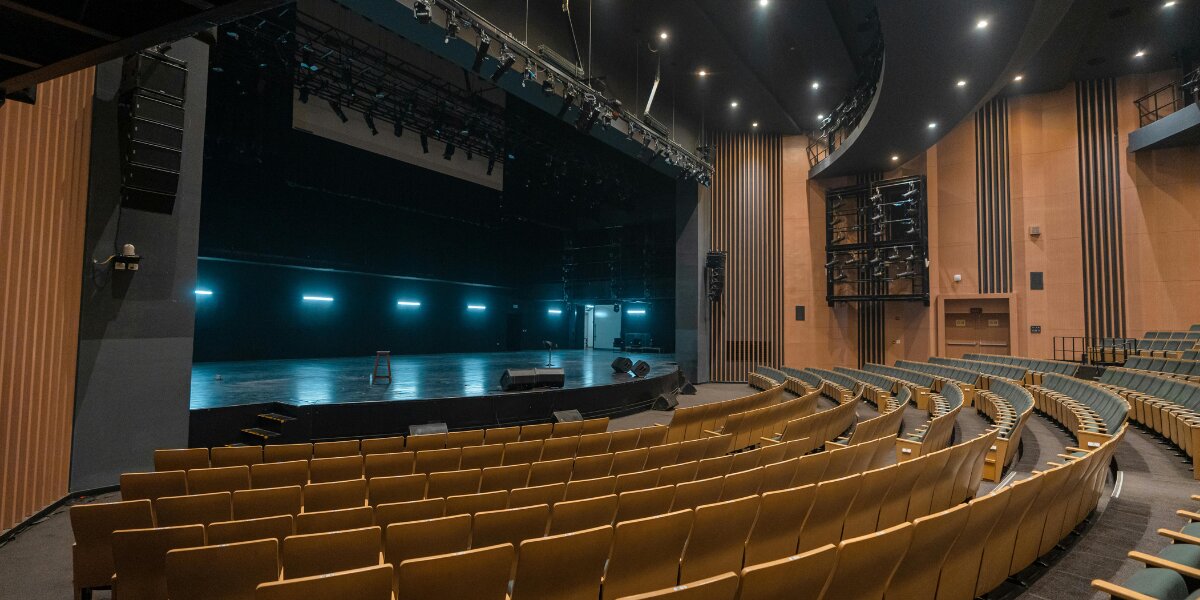
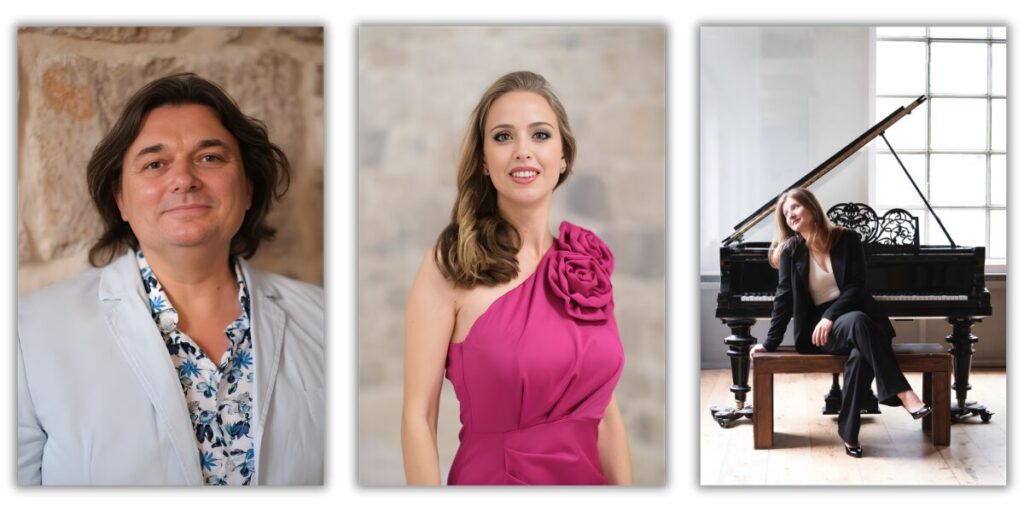
The concert “Works of the First World War”, held on April 10th in the intimate Salon Bösendorfer in Vienna, performed by Montenegrin soprano Sara Vujošević Jovanović, baritone Dmitrij Grinih, and Viennese pianist Lizaveta Bormotova, unfolded as an evening that resembled not merely a historical retrospective but a musical chronicle of a critical moment in history. The program comprised works composed between 1914 and 1918, chosen from composers hailing from countries involved in the First World War. Yet the music did not always confront its historical context directly; often, composers sought refuge in reflective, restrained forms, or intimate genres, creating aesthetic shelters from the turmoil outside. Examples of this include Metner’s Waltz or Stravinsky’s Trois histoires pour enfants, where the psyche finds release and escape through play and childhood imagery.
The hall’s acoustics, warm yet transparent, allowed even the subtlest dynamic shifts and phrasing nuances to be perceptible. Throughout the program, tonality frequently felt provisional, destabilized by distant modulations and chromatic saturation, while fragmented vocal lines and accentuated rhythmic impulses conveyed a persistent sense of tension. Dance forms, such as the waltz, occasionally suggested stability, yet even these passages retained a slight harmonic unease, never providing a fully secure tonal footing. The program, conceived by Sara Vujošević Jovanović, PhD, was guided with thoughtful precision, unfolding as a coherent artistic entity that revealed its formal, semantic, and temporal-cultural layers for nuanced appreciation.
In Ravel’s Kaddish (1914), soprano Vujošević Jovanović shaped the melodic line with meticulous breath control and refined restraint, evoking meditative solemnity without resorting to pathos. Each phrase was carefully rounded, with pronounced attention to textual articulation, while Bormotova’s piano remained airy and supportive, allowing the vocal line to breathe fully and resonate with clarity.
Debussy’s Noël des enfants qui n’ont plus de maison offered a contrasting expression: a declamatory, syllabic line where rhythmic precision and clarity of diction carried the work’s emotional weight. Baritone Grinih commanded dynamic contrasts with poise, balancing lyrical and dramatic moments, while the piano articulated march-like impulses and harmonic tension with measured subtlety. The resulting interplay created a spontaneous, dramatic dialogue, immersing the audience in both the weight of the piece and its attempt at aesthetic release.
In Hindemith’s Schlagt! Schlagt! Trommeln! (1918), Bormotova’s pianism shone through in precise articulation of percussive textures and clear delineation of dynamic layers. The rhythm maintained a mechanical steadfastness, while dissonant chords were rendered with controlled energy. The vocal lines merged with this rhythmic foundation, but the piano remained the anchor of structural cohesion and sonic tension.
Across the program, the repertoire spanned a striking spectrum, from Ravel’s modal subtlety, Debussy’s incisive rhetoric, Rachmaninoff’s dense lyricism, Szymanowski’s expressive flexibility, Prokofiev’s rhythmic inventiveness, Pfitzner’s symbolic narrative, Stravinsky’s fragmentary reductions, Zemlinsky’s chromatic saturation, Respighi’s coloristic diversity, Malipiero’s narrative simplicity, Metner’s formal elegance, Sibelius’ concise lyricism, to Hindemith’s constructive energy. The concert’s dramaturgy relied on contrast and pulsation rather than linear progression, resulting in an experience that constantly shifted in mood and texture.
This program was not a mere illustration of history, but a sonic cross-section of creativity emerging from a destabilized European cultural landscape. The war left traces not only in thematic content but in the very language of music: in fragmented forms, unsettled tonality, heightened rhythmic tension, and dense harmonies. Art could not halt destruction, but in these years it transformed historical pressure into new expressive forms.
In this transformation, from ruptured historical moment to enduring aesthetic value, the concert delivered a poignant message. Each note carried a reminder of the fragility of human life in times of war, of what can be destroyed, but also of the resilience of the human spirit, which finds expression through art. May such devastation remain confined to memory, and may this rich artistic legacy serve as proof that creation always triumphs over destruction.
