
Somtow Sucharitkul’s Mae Naak returns to Bangkok, blending Thai horror and opera into a modern classic with global resonance.
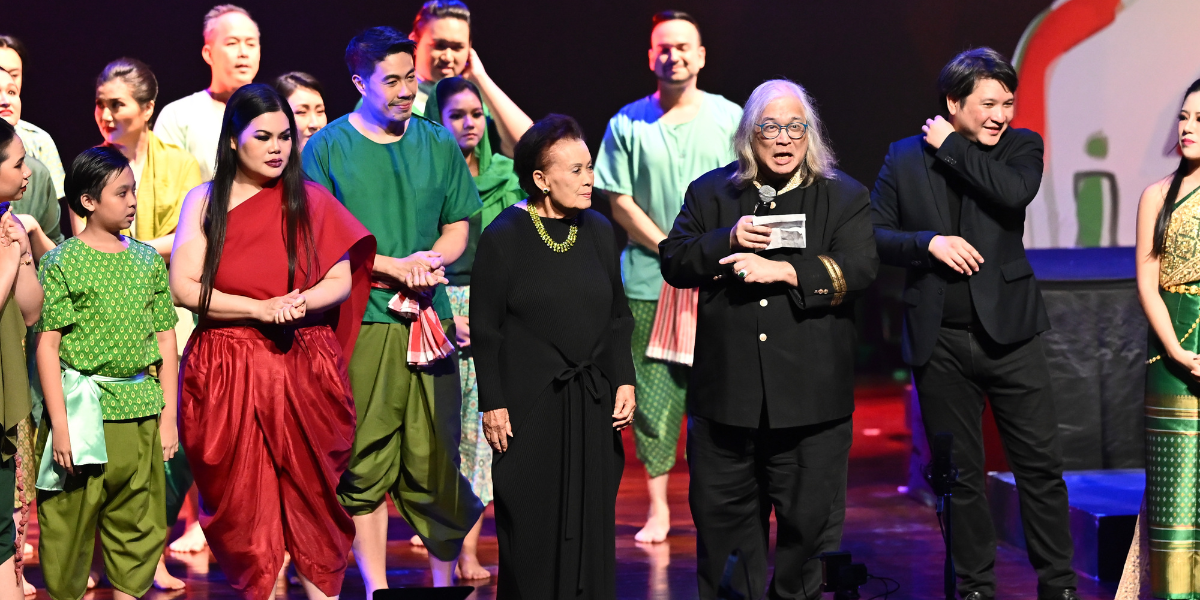
Composer-director Somtow Sucharitkul addresses the audience from the stage of Mae Naak, standing alongside executive producer Thaithow Sucharitkul and conductor Trisdee na Patalung.
On a dimly lit stage in Bangkok, a love story unfolds that refuses to stay buried. A soldier returns home, longing for the wife he left behind, only to discover that memory and reality are no longer the same. What follows is not just a tale of devotion, but a haunting descent into grief, illusion, and supernatural terror. This is the enduring power of Mae Naak, the groundbreaking opera by Somtow Sucharitkul, now revived for a new generation.
First premiered in 2003, Mae Naak marked a bold departure from traditional opera. It fused the emotional intensity of romantic opera with the visceral storytelling of Asian horror cinema. The result was a work that resonated across audiences, drawing in both opera enthusiasts and fans of supernatural drama. Its early success was immediate, and by the time its fourth production reached London in 2011, it had already established itself as a rare cross-cultural triumph.
A New Kind Of Operatic Heroine
Scholars and critics have long recognized the opera’s significance. Japanese academic Kanae Kawamoto noted that “the character of Mae Naak represents a departure from traditional operatic archetypes. Rather than embodying passive tragedy, she is driven by fierce love and an unyielding desire to exist, even beyond death.”
This reinterpretation of the female lead challenges long standing conventions. It places emotional agency at the center of the narrative, transforming Mae Naak into a figure of both empathy and fear. Critics, including those from Fringe Review, have praised the opera as “a striking fusion of European operatic form and Thai folkloric tradition.”
A Revival That Reimagines Reality
The latest revival in Bangkok brings renewed depth to the production. While the original 2003 staging featured designs by Thai National Artist Sumet Jumsai, the current interpretation transforms the stage into a surreal, dreamlike landscape.
 Mae Naak rises from the grave. With Barbara Zion as the ghostly Thai femme fatale and Damian Whiteley as the shaman.
Gone are the conventional depictions of Thai homes. In their place, semi abstract forms in vivid red and green shift across the stage, mirroring the fractured psyche of the protagonist. The set becomes more than a backdrop. It acts as a visual representation of memory itself, fluid, distorted, and haunted.
This artistic choice amplifies the opera’s psychological dimension. The audience is not merely observing a ghost story. They are immersed in a mind struggling to reconcile loss with longing.
Horror And Beauty In Equal Measure
Directed by Sucharitkul himself, the revival leans fully into the duality that defines Thai horror. Moments of grotesque terror are juxtaposed with scenes of lyrical beauty and emotional intensity. This balance is not accidental. It reflects a storytelling tradition where humor, horror, and humanity coexist.
The opera does not shy away from its darker elements. It is one of the few operatic works where visceral horror is depicted so explicitly. Yet, these moments never feel gratuitous. Instead, they heighten the emotional stakes, reinforcing the tragedy at the story’s core.
The role of Mae Naak, originally created for soprano Nancy Yuen, is reimagined in this production by Thai soprano Barbara Zion. Her performance is both technically demanding and emotionally resonant. The delicate pianissimo passages and soaring vocal lines are delivered with precision, marking a significant milestone in her career.
Opposite her, Singaporean tenor Martin Ng portrays the husband whose return from war sets the tragedy in motion. His interpretation introduces a psychological layer to the narrative. The character’s actions can be viewed not only as supernatural encounters but also as manifestations of trauma, echoing themes of post war disorientation.
A Modern Classic With Global Reach
With each revival, Mae Naak continues to evolve. Its adaptability is a testament to its strength as a modern classic. The opera’s themes of love, loss, and denial remain universally relatable, allowing it to resonate across cultures and generations.
Sucharitkul’s broader body of work further underscores his influence. Recognized as a National Artist of Thailand, he has built a repertoire that bridges Eastern and Western traditions. His ambitious projects include DasJati, a ten part operatic cycle exploring the final incarnations of the Buddha, and Ayodhya, a condensed retelling of the Ramayana.
Other works draw from his experiences in the West. The Snow Dragon explores the relationship between a school counselor and an abused child in Florida, while Helena Citronova is inspired by a true story set during the Holocaust. This range reflects a composer unbound by geography, committed instead to storytelling that transcends borders.
 Tenor Kittin Suchato in Mae Naak as a pork merchant who tries to seduce the ghost of Mae Naak and ends up literally losing his head.
International recognition has followed. The European Cultural Forum honored him with the European Cultural Achievement Award, while critics such as the Houston Chronicle have described his compositions as rich and lyrical. Publications like Opera Magazine have even credited him with positioning Bangkok as a key operatic hub in Southeast Asia.
Innovation That Continues To Surprise
Even after decades of achievement, Sucharitkul shows no signs of slowing down. His latest project, an operatic adaptation of the cult film Plan 9 from Outer Space, reflects his willingness to experiment with unconventional material. Early excerpts, performed during a Siam Sinfonietta tour in Malaysia, hint at a production that blends humor, nostalgia, and inventive orchestration (including a police siren and a telephone!).
This forward thinking approach ensures that his work remains relevant. It also reinforces his reputation as a composer who is unafraid to challenge expectations.
Discover The World Of Mae Naak
For audiences seeking an experience that goes beyond traditional opera, Mae Naak offers something truly distinctive. It is a work that merges cultures, genres, and emotions into a single, unforgettable performance.
As it continues to captivate viewers in Bangkok and beyond, the opera stands as a reminder of what happens when storytelling dares to evolve. It invites audiences to explore not only a haunting tale, but also the boundaries of artistic expression itself. You can also check more information on their website.
