
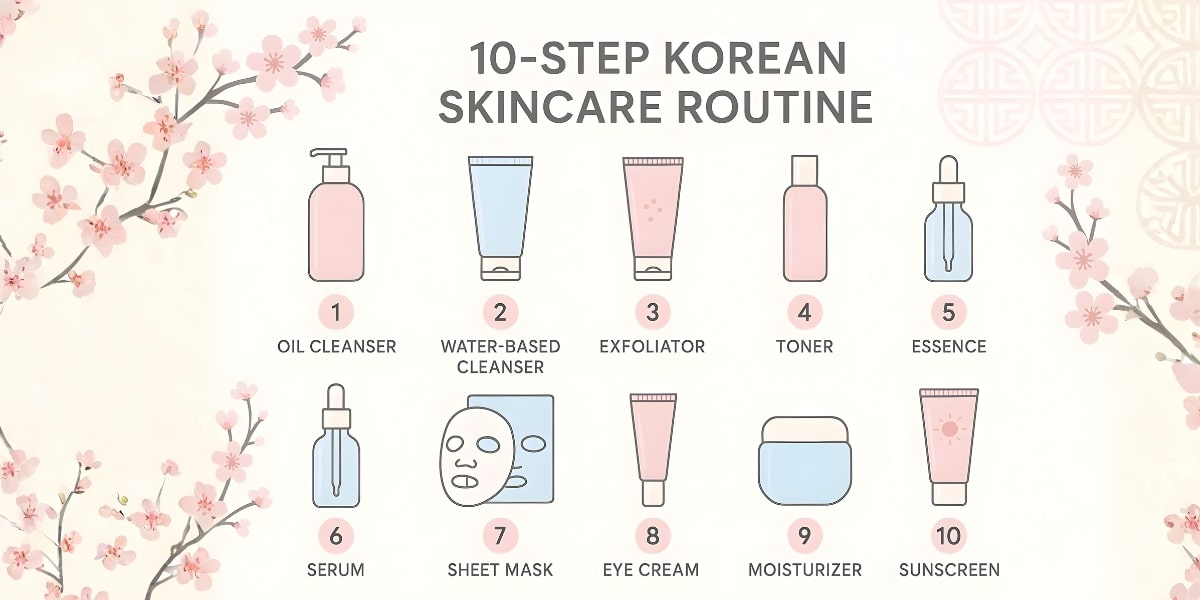
A 10-step Korean skincare routine can seem daunting for sensitive skin, but K-beauty focuses on gentle, targeted care.
The principles that make it so effective can be your greatest ally in calming and nurturing your reactive skin. This article takes a closer look at how to build a Korean-inspired routine that prioritizes skin health and tranquility.
Rethinking the 10 Steps: A Philosophy of Intention
First, let’s clear the air. The “10-step routine” is more of a marketing concept than a strict rule. It represents the maximum number of categories available, not a daily mandate. For sensitive skin, the goal is the opposite of more. Your focus should be on a minimalist, intentional routine using products with soothing, barrier-supporting ingredients. The core tenets of Korean skincare, hydration, gentle cleansing, and protection, are precisely what sensitive skin craves.
Your version of a K-beauty routine might have four or five steps, and that’s perfect. The aim is not to collect products but to understand what your skin needs and deliver it consistently. Think of it as a dialogue with your skin. Is it feeling tight? It needs more hydration. Are you seeing some redness? It’s asking for calming ingredients. This responsive approach is far more effective than blindly following a prescriptive list. It empowers you to become your own skin expert, choosing only what serves you and leaving the rest behind.
This means becoming a diligent reader of ingredient lists. Instead of being swayed by beautiful packaging or trendy names, you’ll look for calming heroes like centella asiatica (often called cica), mugwort, green tea, and panthenol. You’ll also learn to spot potential irritants, such as artificial fragrances, drying alcohols, and certain essential oils, which can be triggers for reactive skin.
As Joseph Kim, Founder & CEO of Incellderm, notes, “Understanding the cellular impact of what we apply to our skin is paramount. When you become a discerning reader of ingredient lists, you’re not just identifying trendy components, but rather seeking out bio-active natural compounds that truly support cellular repair and resilience, while consciously avoiding elements that can disrupt the skin’s delicate ecosystem.”
The Gentle Art of the Double Cleanse
The double cleanse is a cornerstone of Korean skincare, designed to thoroughly remove makeup, sunscreen, and daily grime without stripping your skin’s natural moisture barrier. For sensitive types, this step can be intimidating, but when done correctly, it’s remarkably gentle and effective. It’s a two-part process that ensures your skin is truly clean and ready to absorb the nourishing products that follow.
Start with an oil-based cleanser to dissolve oil-based impurities like sebum, SPF, and makeup. Choose a fragrance-free balm or oil with ingredients like jojoba or grapeseed oil. Massage it into dry skin in circular motions, then add water to emulsify the oil into a milky liquid that rinses away impurities cleanly, leaving your skin fresh and clean.
The second step is a water-based cleanser. This is where you wash away any remaining residue and water-based impurities like sweat and dirt. The key here is to choose a low-pH, hydrating cleanser. A high-pH (alkaline) cleanser can disrupt your skin’s acid mantle, leading to dryness and irritation. Look for gel or cream cleansers that are labeled as “gentle” or “hydrating” and are free of harsh sulfates like SLS. Your skin should feel clean, soft, and comfortable after cleansing, never tight or squeaky.
Layering Hydration: Toners, Essences, and Serums
After cleansing, your skin is a clean canvas, perfectly prepped for hydration. This is where the Korean art of layering truly shines. Instead of applying one thick, heavy cream, the K-beauty method involves applying several thin, watery layers of hydrating products. This allows the skin to absorb moisture more effectively and avoids the suffocating feeling that some heavy moisturizers can cause.
As Htet Aung Shine, Co-Founder of NextClinic, notes, “The parallel between skincare layering and modern healthcare delivery is striking: by breaking down complex needs into manageable, sequential steps, we enhance efficacy. Telehealth embodies this, moving beyond a single, heavy intervention to offer tailored consultations, prescriptions, and referrals. This layered approach ensures that essential care is ‘absorbed’ more effectively, making healthcare accessible and less daunting, much like how light layers prevent skin from feeling suffocated.”
Start with a toner. Forget the harsh, alcohol-based astringent toners of the past. Korean toners are hydrating and soothing, designed to balance your skin’s pH and provide the first layer of moisture. For sensitive skin, seek out toners with ingredients like mugwort, chamomile, or beta-glucan. You can apply it with a cotton pad, but many prefer to pour a small amount into their palms and gently pat it into the skin for maximum absorption.
Next comes the essence or serum. These are concentrated treatments that target specific concerns. While an essence is typically more lightweight and focused on hydration, a serum might be slightly thicker and packed with actives to address issues like redness, dehydration, or a compromised skin barrier. For a sensitive-skin-friendly routine, a serum containing centella asiatica, madecassoside, or ceramides can work wonders to calm inflammation and strengthen your skin.
As Benson Kuria Macharia, CTO of TranslitePharma, notes, “While essences and serums are both vehicles for concentrated treatments, the true efficacy, especially for sensitive skin, lies in the molecular precision of the active ingredients. From a pharmaceutical science standpoint, the effectiveness of compounds like centella asiatica or ceramides isn’t merely anecdotal; it’s about their proven ability to modulate cellular responses, strengthen the skin barrier at a physiological level, and calm inflammation through specific biochemical pathways, ensuring genuine therapeutic impact.”
Always patch-test a new serum on a small area before applying it to your entire face. Introduce only one new product at a time so you can easily identify the source of any irritation.
Barrier Repair: Finding Your Perfect Moisturizer
A healthy skin barrier is your first line of defense against environmental irritants, bacteria, and moisture loss. For sensitive skin, this barrier is often compromised, which is why it reacts so easily. The role of your moisturizer is to seal in all the hydrating layers you just applied and to provide the building blocks your skin needs to repair and strengthen its barrier.
As Bill Sanders, from QuickPeopleLookup, notes, “Just as a robust security protocol protects sensitive information, your skin’s barrier acts as a critical firewall, actively preventing breaches from irritants and maintaining essential hydration. When that defense is compromised, everything becomes vulnerable, much like an unencrypted data stream. A good moisturizer, then, isn’t just about comfort; it’s about rebuilding and fortifying that essential structural integrity.”
Look for moisturizers rich in ceramides, which are lipids that naturally occur in your skin and are essential for barrier function. Panthenol (a form of vitamin B5) is another fantastic ingredient that soothes, hydrates, and promotes healing. Squalane is a lightweight, non-comedogenic oil that mimics your skin’s natural sebum, providing moisture without feeling greasy.
The texture you choose depends on your skin type and the climate. A lightweight gel-cream might be perfect for oily or combination skin, or for use during hot, humid months. A richer, thicker cream will be better suited for dry skin or for providing extra protection during cold, windy weather. Don’t be afraid to have two different moisturizers on hand to adapt to your skin’s changing needs throughout the year. The goal is to leave your skin feeling plump, comfortable, and protected.
As experts from Lashkaraa.com, Modern Sarees specialists notes, “Understanding the nuances of fabric and drape is paramount, much like selecting the right moisturizer for your skin. For modern sarees, the goal is always to harmonize the textile’s breathability and fall with the climate and the wearer’s comfort, ensuring that elegance never compromises ease, whether it’s a lightweight georgette for a summer day or a richer silk for a cooler evening.”
Conclusion
Building a Korean-inspired routine for sensitive skin is ultimately an exercise in restraint and intention. By stripping away the unnecessary and focusing on core principles, gentle cleansing, ample hydration through layering, barrier repair, and diligent sun protection, you transform the daunting 10-step process into a simplified, powerful ritual.
The true success of this approach lies not in the number of products you use, but in the consistency of your commitment to soothing and strengthening your skin’s natural defenses. Embrace the slow, gentle path; it is the most effective way to achieve a calm, resilient, and truly radiant complexion.
